Written: 23 November 2026 · Checked: 23 November 2026
Data current as of late November 2026. We update this article, so check back for updates.
Contents
- The 30-second version
- How people search now
- Why it’s months, not years
- The three "geos" in one table
- What you lose if you do only one
- How an AI assistant builds an answer about a local business
- The own-browser trap
- The work, in order
- What I advise against
- Checklist: check yourself in 15 minutes
- Case studies
- About the author
- Questions and answers
- Glossary
- What is a rule and what is our experience
- Sources
1. The 30-second version
- The word "geo" now hides three different things: geomarketing (where your customers are and where they come from), local SEO (being found nearby: maps, reviews, directories) and GEO (AI assistants such as ChatGPT, Gemini, Claude and Perplexity describing you correctly).
- More and more customers ask an AI assistant for advice, and it names a few places instead of ten links.
- The assistant builds its answer from maps, reviews, directories and websites. That is why each "geo" on its own works poorly.
- Together they bring the customer: the assistant names you, the map shows the way and the reviews, directories confirm you are real.
- What to do today: from someone else’s phone, ask an AI assistant where to find what you sell in your city, without naming your business. If you are not in the answer, your competitors are.
2. How people search now
When I ask owners what "geo" means to them, I almost always hear the same thing: location, maps, being on the map. A typical line: "We’re already on the map, whoever needs us will find us." Almost nobody thinks of "geo" as AI assistants. And when I ask how local SEO differs from geo, many get confused. That’s normal: the words are similar, but they mean three different things.
Here is what has changed in how people choose a place or a service:
| Situation | Before | Now |
|---|---|---|
| Where to eat, where to go tonight | Asked neighbours, friends, colleagues; searched Google | Ask an AI assistant: "recommend a pizza place nearby" |
| Choosing a tradesperson, doctor, lawyer | Word of mouth, a directory, friends of friends | Ask an AI assistant, then check reviews on the map |
| Study, health, family, work | Books, forums, people they know | Many questions go to an AI assistant first |
| What the answer looks like | Ten links, the person chooses | A few names and short advice |
| Whom they trust | Someone they know personally | An answer that looks like advice, not an ad |
What the research shows. In a BrightLocal survey (1,002 US adults, published 11 February 2026), 45% said they had used ChatGPT or another AI tool for local business recommendations in the past year, up from 6% a year earlier. 40% trust AI for this and 32% do not. It is a US survey of what people say they do. We have not found equivalent public surveys for Norway, Sweden, Denmark, Finland or Georgia, so read the figures as a direction, not a forecast for your city.
The most convincing thing I show a client is right there on the screen, in front of them. I type, for example: "I want pizza, recommend a pizza place in Oslo." The assistant names places at once, and they are competitors. The client gets indignant: our prices are lower, our pizza is better, we use more toppings, our reviews are better. A local business often thinks everyone already knows it.
Then I ask: do you trust ChatGPT or Claude yourself? People trust them because they see advice in the answer, not an ad, and the more they talk to them, the more they trust them. You ask them what film to watch tonight, where to buy tickets cheaper, how to save money. Why do you think the assistant will look for you, not your competitors, if you have not told it about your business and "packaged" it properly?
The conclusion is simple: if you are not in the AI answer, your competitors are.
3. Why it's months, not years
I don’t promise deadlines: nobody outside knows exactly how AI assistants and maps choose businesses. But here is what I see in my work. We catch the first new mentions of a client, ones that were not there before, on screenshots one, two or three weeks after work starts. So I draw the client a horizon not of years but of one month, three months, six months and a year.
The other side: your competitor is not standing still either, and their lead grows every month. I explain it in plain numbers, with reviews.
- If you get at least one review a day from real customers, you will have more than 300 in a year.
- You have been open five years and have 12 reviews, 6 of them positive, the rest three or four stars. Your competitor has 300, 280 of them positive.
- Your average is 4.0 with 12 reviews. One 1-star review arrives (whether it’s your fault or not doesn’t matter), and your average drops to 3.8: (12 × 4.0 + 1) / 13 = 3.77. Your competitor has 300 reviews and an average of, say, 4.8: the same 1-star review gives (300 × 4.8 + 1) / 301 = 4.79, and the listing still shows 4.8.
- Put yourself in the customer’s place: one restaurant has 12 reviews, the other 300. Where would you go?
Reviews only from real customers. No fake reviews: Google’s rules prohibit fake reviews, incentives for reviews and pressuring customers, and a sudden flood is visible from outside (more in What I advise against and in how to ask for reviews within the rules).
4. The three "geos" in one table
| Geomarketing | Local SEO | GEO (Generative Engine Optimization) | |
|---|---|---|---|
| What it is | Working with place: where your customers live and work, where they come from, what radius, where your competitors are | Being found nearby: Google Business Profile, maps, reviews, local directories, website | Getting AI assistants to describe you correctly and name you in their answers |
| The customer’s question it answers | "Is it far from me? Is it easy to get to?" | "What’s nearby, is it open now, what are the reviews?" | "Recommend where to go" or "whom to choose" |
| Where it works | Your decisions: where to open, whom to target, what radius for ads | Google Maps, Apple Maps, Bing, local directories, your website | ChatGPT, Gemini, Claude, Perplexity, Google’s AI Mode, Copilot |
| How to measure | Where customers come from: asking them, delivery addresses, direction requests in Business Profile performance | Calls, directions and website clicks in Business Profile performance; number and freshness of reviews; consistent details everywhere | Regular checks from someone else’s device: are you named, what is said, which sources are cited; dated screenshots |
| Time to first changes (in our experience) | Depends on the decision, we give no timing | Horizon: one month, 3 months, 6 months, a year; no exact date can be promised | First new mentions on screenshots 1-3 weeks after work starts |
Where the word GEO comes from. Researchers proposed the term in the paper "GEO: Generative Engine Optimization" (Pranjal Aggarwal, Vishvak Murahari and co-authors; Princeton University, IIT Delhi and others). The first version appeared on arXiv on 16 November 2023, and the paper was published at KDD 2024. The authors describe how search engines that write their own answers build them from several sources, and they propose ways to make your content appear in such answers more often. In their lab tests a source’s visibility rose by up to 40%. That was a test on a set of queries, not local business experience, so do not take the figure as a promise.
So "geo" in a conversation with a marketer can mean any of the three. Ask directly: are we talking about the map and the radius, the listing and the reviews, or AI assistants?
5. What you lose if you do only one
| If you only do… | What works | What breaks |
|---|---|---|
| Maps (Business Profile) | People find you nearby, see the route and hours | The assistant checks you against other sources. If directories show an old address or a poor rating, the picture is confusing for people and AI alike |
| Directories | There are confirmations that you are real | Without a live map listing there are no fresh reviews, route or hours; the customer finds you but doesn’t arrive |
| Website and articles | You catch searches for your name and tell your story | A local customer searches on the map. Without a listing and reviews, a website alone won’t bring someone from the next street |
| AI assistants (GEO) with nothing else | Nothing: there is nothing to "package" | The assistant takes information from maps, directories, websites and reviews. If they are empty or wrong, it will retell emptiness or errors |
The data shows the same. Yext analysed 6.8 million source citations in answers from ChatGPT, Gemini and Perplexity (collected 1 July to 31 August 2025, press release of 9 October 2025): 44% pointed to the businesses’ own websites, 42% to directories and listings, 8% to reviews and social media. Almost everything the assistant draws on about you is within your reach.
6. How an AI assistant builds an answer about a local business
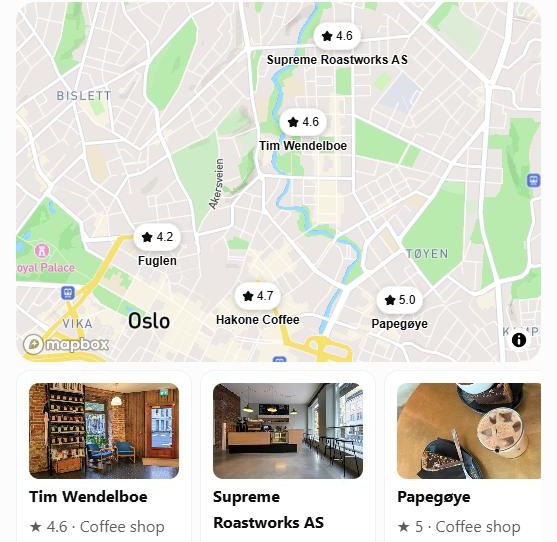
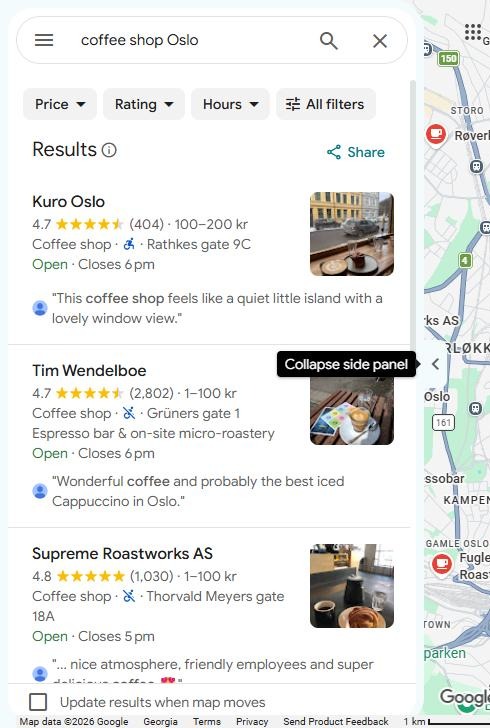
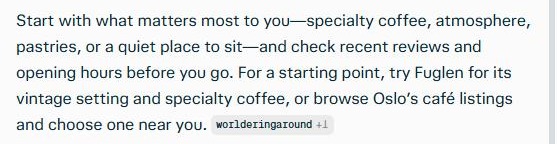
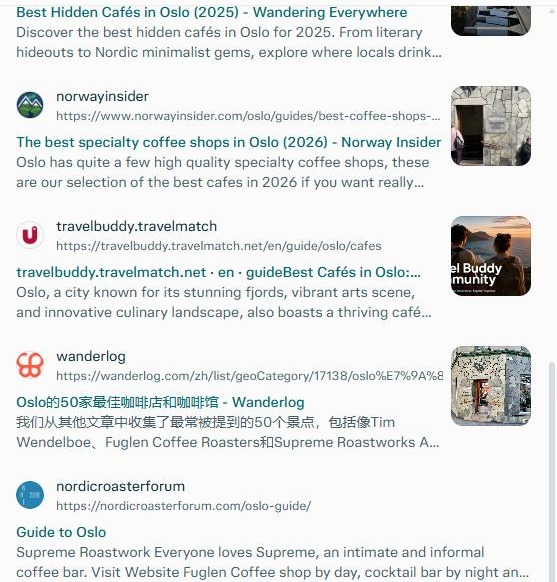
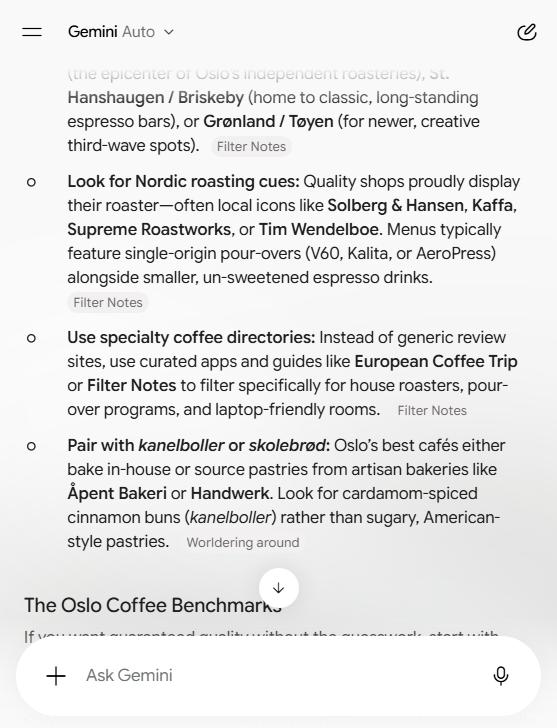
We checked it ourselves. On 23 November 2026 we asked the same customer question, "How do I find a good coffee shop in Oslo?", in several AI assistants and in Google Maps.
| Where | How we checked | What we saw |
|---|---|---|
| Perplexity | Not signed in, clean browser, 13:12 Tbilisi time | One coffee shop and 10 sources, all travel guides and café lists; Google Maps was not among the sources |
| ChatGPT | Not signed in, 13:15 | Five coffee shops; under the list, according to our record of the answer (no screenshot), a line saying the selection was informed by guides and local business listings |
| ChatGPT, repeat | New chat, not signed in, about 13:30 | A different set and a map with ratings; no line about listings: answers change from run to run |
| Claude | Owner’s account, incognito mode (no memory), about 13:28 | The answer starts with a map: seven places with ratings from maps; no directories named |
| Gemini | Owner’s account, temporary chat, about 13:32 | Among its tips: "Use specialty coffee directories" |
| Google Maps | English interface, 13:34, search "coffee shop Oslo" | Kuro Oslo 4.7, Tim Wendelboe 4.7, Supreme Roastworks 4.8 |
| Copilot | Not checked | Requires sign-in |
What this shows. Claude and ChatGPT open their answer with a map and ratings, and two coffee shops, Tim Wendelboe and Supreme Roastworks, appear in both answers and in Google Maps. In three of five checks the assistant relied on guides and directories or advised them. That is why in my order of work maps and reviews come first and directories second. One question in one city is an example, not a rule. You can repeat the check for your field in five minutes: In 5 minutes and 3 steps: check yourself in AI answers.
7. The own-browser trap
This is the most common mistake I see owners make, and it opens their eyes better than any figures.
The owner checks themselves from their own phone or browser. Their Google and ChatGPT already know it is their business, or that they open it often. On top of that they ask the "wrong" questions: "find pizza places similar to [name]", "which salons compete with our salon [name]". The name is already in the question, so their salon is in the answer, with competitors next to it. The owner is happy.
Now a local question without the name, the way a customer asks it: "where can I get an affordable blow-dry in the city centre". And the salon is not in the answer.
Why. Google’s help describes this for its search: results differ between people because of location, language and device, and, when personalization is on, because of search history and activity. How each AI assistant adapts is not disclosed, so the salon example is our experience, not a rule.
How to check properly:
| Wrong | Right |
|---|---|
| From your own phone, signed in to your accounts | From a friend’s phone or a private window, in a new chat with no history |
| "Find places similar to [name]" | "Where in [city] can I find [service] cheap / nearby / open now" |
| Once | Two or three assistants, on different days; see what repeats |
| By name only | First without the name, then a direct question about the business: what is written about it and its reviews |
Step by step, with ready-made prompts: the 5 minutes and 3 steps hub, question "Why check from someone else’s phone?".
8. The work, in order
Where I start
First, an audit of what exists. We compare what the client wrote in the brief with what is actually out there. Then we ask directly what else there has been. Then we monitor ourselves. Very often a client has listings in local directories and forum threads about them and doesn’t know: nobody monitored it, the marketing team wasn’t paid to.
Then the brand. We look at how branded searches perform, for example "coffee shop + name", and show the client what it really looks like from someone else’s device (see the own-browser trap).
Then a plan in three packages. Prices depend on the field and the scope, so here is only what is included:
| Package | What is included |
|---|---|
| Basic | Map and directory listings put in order, mentions put in order, monitoring of everything said about you on forums, blogs and Reddit, and prepared replies |
| Standard | Everything in Basic, plus replies, a brand website, photos, social media |
| Premium | Everything in Standard, plus promotional articles and interviews, and control of the first 10-20 search results |
Our services and ways to work with us.
Seven areas
1. Google Business Profile
- Why: it’s the first thing people see on the map. In our checks, AI assistants often open a local answer with a map and ratings (section 6). Google’s help says businesses with complete and accurate information are more likely to show up in local results.
- What to do: make sure the listing is verified; choose an accurate primary category; fill in hours, services, description; add real photos.
- How to check: from someone else’s phone, find yourself by category ("pizza near me"), not by name.
- Read: how to add your business to Google and Google Maps, choosing a primary category, which photos to add.
2. Local directories
- Why: in my checks AI assistants name them second or third after maps, and in Yext’s data 42% of citations in AI answers pointed to directories and listings. This is my experience, not a rule of any assistant.
- What to do: find where you already are (often a surprise), fix old details, add yourself to the right directories. Examples of such directories are ours: madloba.info (Georgia), norgeguide.com (Norway), sverigesforetagsguide.se (Sweden), denmarkguide.dk (Denmark), suomiguide.fi (Finland).
- How to check: find yourself in three to five local directories; do the address, phone and hours match; is there an old poor rating.
- Read: directories in Norway, Sweden, Denmark, Finland, directories in Georgia, how to build citations yourself, step by step, do I need Bing, Apple Maps in Scandinavia and Georgia.
3. Reviews with photos
- Why: in BrightLocal’s 2026 survey 74% look at reviews from the last three months and 31% will only use a business rated 4.5 or higher. People and AI both see fresh reviews and ratings. The review arithmetic is in section 3.
- What to do: ask happy customers after the visit, by link or QR code; reply to every review, good and bad.
- How to check: how many reviews in the last three months, what average, how many you replied to.
- Read: how to ask for reviews within the rules, review link and QR code, asking by SMS and WhatsApp, how to reply to reviews.
4. Website and markup
- Why: not every business needs a website for customers, but almost every one needs it for GEO. An example from my work: a car service with detailing promotes itself on the map and doesn’t need a website for customers: nobody drives across town to a car wash or tyre shop. But GEO needs a funnel that catches branded searches: a brand website with details about the company and services, reviews, contacts, the owner, the team, the company’s story. Many owners have an interesting story that only they and some staff know. Photos work very well now in several fields, for example detailing and dentistry. In Yext’s data, 44% of citations in AI answers pointed to the businesses’ own websites.
- What to do: an "About us" page with the story and the team, service pages, contacts and hours matching the listing, photos of your work. LocalBusiness markup helps search engines read your name, address, phone and hours.
- How to check: from someone else’s phone, search "name + city" and see what is at the top: your website or someone else’s directories.
- Read: ChatGPT shows wrong information about my business: where it comes from; do I need LocalBusiness schema markup on my website.
5. Promotional articles and interviews
- Why: if you don’t control the top results for your name, other people’s directories and listings do. Often nobody looks after a directory, and poor ratings sit there. We had a case: first place, Google Maps with a 4.8 rating; second, someone else’s local directory with 2.8; third, a forum review about 15 years old, with the old interior, old staff and a negative rating. People don’t dig into details, they look at the whole picture.
- What to do: articles and interviews with links, as a story that interests people: about the owner, the team, offers. Our task is to push out the rest and control the first 10-20 results in Google, Bing, wherever.
- How to check: search "name + city" from someone else’s device, scroll the first 10-20 results and mark which are yours.
- Read: what an AI visibility agency can honestly promise.
6. LinkedIn and social media
- Why: in our observations, AI assistants take into account practically all social networks. Social media helps with hiring, reputation and reviews. Customers like a business to have a face, so it’s clear whom to complain to or bring an offer to. This matters most in financial institutions and wherever you can’t reach the director. LinkedIn works very well for this.
- What to do: not just a page but useful content. A coffee shop can share tips on how to brew and drink coffee properly, so people see specialists work there. Post offers there too. Short useful how-to videos on TikTok, YouTube, Instagram: not ads but help for the viewer; they show expertise, and in our observations AI assistants pick them up too. Everything is individual.
- How to check: does the business have a "face" (an owner or manager with a clear profile); is there useful content, not only offers.
7. The same details everywhere
- Why: name, address, phone and opening hours (NAP) must match on maps, your website, directories and social media. If they differ, the assistant may retell old details.
- What to do: write one "master" line and check every place against it.
- How to check: how to check that your name, address and phone match.
- Read: what NAP is and why it must match everywhere.
Why it works
Literally within one, two or three weeks we start taking screenshots and showing the client: here you weren’t mentioned, here a mention appeared. Then the task is to push out the rest and keep the top results under control. It works only if you do it all together and for a long time.
9. What I advise against
- Faking it. A typical mistake: the owner wakes up, goes to their marketers, and a sudden flood of reviews, articles and press releases begins. Go step by step instead: 10 articles this month, 15 next month, then 20. The client sees it works and starts investing in good platforms, articles and case studies.
- Fake reviews and fake praise articles. Google’s rules treat bought and fake reviews as fake engagement and do not allow pressuring customers or offering incentives for reviews.
- Running a sprint instead of a marathon. Many write 10, 20, 30 articles, fill in the listing and forget about it. That doesn’t work. This is systematic work.
- Starting without an audit. Always an audit first, then a strategic and tactical plan and the expected result, then adjustments on the ground. You can’t make a perfect plan at once, there are many nuances, and that is why a specialist helps.
- Hiding your knowledge. Show it on your own website: a knowledge base (as we do at Madloba Consult), free PDF guides.
10. Checklist: check yourself in 15 minutes
- From someone else’s phone, in a new chat, I asked an AI assistant about my field in my city without my business name. Am I in the answer?
- I asked the same question in a second assistant.
- I asked directly: "What do you know about [name] in [city]? What are its reviews?" Is it all true?
- I looked at whom the assistant recommends instead of me and opened their map listings.
- My Google Maps listing is verified and the primary category is accurate.
- Hours, phone and address on the map match my website.
- There are fresh real photos of the place, the work, the team.
- I counted reviews from the last three months and my average; compared with my main competitor.
- I replied to every review, including the bad ones.
- I found myself in three local directories; details match, no old poor ratings.
- I searched "name + city" from someone else’s device: what is in the first 10 results, how much of it is mine.
- I searched my name on forums and blogs (and on Reddit, if my customers are there).
- The business has a "face": the owner’s or manager’s profile on LinkedIn or another network.
- My website has a page about the company: story, team, contacts, reviews.
- I noted the date and took screenshots, to compare in a month.
Free guides and checklists: madlobaconsult.com/guides.
11. Case studies
Honestly: we are building case studies on exactly this combination of maps, directories and AI assistants right now, and we will publish them when we have results we can show. Finished case studies on maps and reviews are in our case studies section.
One example from my experience, without a name or figures. We suggested that a wedding agency post its photos on Pinterest and make PDF guides: how to prepare for a wedding, table settings, bouquet ideas. It worked very well, including in AI answers. The idea is simple: use every channel where your customer looks for ideas. But everything is individual.
12. About the author
I’m Alex Nekrashevich. I work on local marketing and on how businesses show up in AI assistants’ answers: Google Maps, reviews, ChatGPT and others. Google Product Expert since January 2019 in the Google Business community, Google Maps Local Guide level 10 (as of 20.11.2026: 1,101 reviews, 12,701 photos). Founder of Madloba Consult. Freelancing since 2015, with more than 2,000 completed freelance orders. I work with businesses in Georgia and Scandinavia.
"Madloba" means "thank you" in Georgian. It started with madloba.info, a directory of Georgia: collecting information people would say thank you for. That’s where Madloba Consult got its name. I run the YouTube channel Local marketing and SEO on maps. The easiest way to reach me is LinkedIn. More about me.
13. Questions and answers
Are geomarketing and local SEO the same thing?
No. Geomarketing answers "where are my customers and where do they come from". Local SEO answers "will people find me nearby": the map listing, reviews, directories. They are related but different work.
What is GEO?
Generative Engine Optimization: work to make AI assistants (ChatGPT, Gemini, Claude, Perplexity and others) describe you correctly and name you in their answers. The term comes from a 2023 research paper. For a local business, GEO rests almost entirely on maps, reviews, directories and the website.
Can I pay to get into ChatGPT’s answers?
Not into the answer itself. OpenAI has been testing ads in ChatGPT since February 2026 and is expanding them country by country, but according to the company ads are labelled, shown separately from the answer and do not influence it. Check OpenAI’s page for where ads are available. A place in the answer itself is earned through what sources say about you.
How much does it cost?
Much of it is free: a Google listing, basic entries in most directories, asking for reviews. You pay someone who does it for you. We have three service packages (section 8); the price depends on your field and scope. And be careful with anyone who promises a guaranteed place in AI answers: what an agency can honestly promise.
Where do I start if I have no time?
With the five-minute check from someone else’s phone: 5 minutes and 3 steps. Then your Google Maps listing. That gives the most for the least time.
Do I need a website?
For customers, not always: people find a car wash on the map. For GEO, almost always: the website catches searches for your name and gives the assistant details about the company, team and story. In Yext’s data, 44% of citations in AI answers pointed to company websites.
Why directories if there’s Google Maps?
Because the assistant wants several confirmations, not one. In our checks on 23.11.2026, assistants relied on guides and directories or advised them in three cases out of five. And if someone else’s directory shows an old poor rating, people will see it next to your 4.8 on the map.
How do I check what an AI assistant says about us?
From someone else’s phone, in a new chat, first without your name, then with a direct question about the business. Two or three assistants, different days. Step by step: how to check ChatGPT and Gemini recommendations.
The assistant says something untrue about us. What should we do?
Find the source: often an old directory entry or an old review. Fix it there and ask again. More: ChatGPT shows wrong information about my business.
Does this work for a personal brand?
Yes. A doctor, lawyer, tradesperson or coach follows the same steps, checking their name and profession in their city instead of a company name. Not every professional may have their own map profile under Google’s rules: see Google’s guidelines.
How often should I check?
In our practice, once a month and after any change of name, address, phone or hours. Dated screenshots help you see progress.
What will change in 2027?
Nobody knows exactly. We will update this article when new research comes out or platform rules change.
14. Glossary
- Geo. A short word now used for three different things: geomarketing, local SEO and GEO. Ask which one is meant.
- Geomarketing. Working with place: where your customers are, where they come from, what radius, where competitors are.
- Local SEO. Being found nearby: maps, reviews, directories, website.
- GEO (Generative Engine Optimization). Getting AI assistants to describe you correctly and name you in their answers. The term comes from a 2023 research paper.
- AEO (Answer Engine Optimization). A related term: getting your content into ready-made answers from search engines and assistants. There is no single definition; it is often used almost as a synonym for GEO.
- LLM (large language model). The technology behind ChatGPT, Gemini, Claude and other AI assistants.
- NAP. Name, Address, Phone. Must match everywhere.
- Google Business Profile. A business’s listing on Google Maps and Search.
15. What is a rule and what is our experience
- Platform rules and data: Google’s review rules (fake reviews, incentives, pressure); Google’s statement that complete and accurate information helps in local results; that search results differ between people by location, language, device and, with personalization, search history; OpenAI’s statement that ads in ChatGPT are separate from the answer.
- Research (not Google’s data): the paper "GEO: Generative Engine Optimization" (2023, KDD 2024); BrightLocal 2026 (45% and 6%, 40% and 32%, 74%, 31%); Yext 2025 (44%, 42%, 8%).
- Our experience, not rules: how clients understand the word "geo"; first new mentions on screenshots after 1-3 weeks; the "one month, 3 months, 6 months, a year" horizon; in my checks maps first, directories second or third; the own-browser trap and the salon example; the "4.8 on the map, 2.8 in a directory, a 15-year-old review" example; the car service and website example; the wedding agency and Pinterest; the three packages and the order of work; the 10, 15, 20 articles staircase; checking once a month.
* Where we write "in our experience", it is what we have seen on our clients’ listings, not a platform rule. Platforms do not disclose their algorithms, and we may be wrong.
16. Sources
- Aggarwal P., Murahari V. et al., GEO: Generative Engine Optimization, arXiv 2311.09735, first version 16.11.2023, KDD 2024: https://arxiv.org/abs/2311.09735 (read 23.11.2026)
- BrightLocal, Local Consumer Review Survey 2026, published 11.02.2026, 1,002 US adults: https://www.brightlocal.com/research/local-consumer-review-survey/ (read by HQ 23.11.2026)
- Yext, study of AI answer sources, press release of 09.10.2025: https://www.yext.com/about/news-media/ai-citations-release
- OpenAI, Testing ads in ChatGPT, published 09.02.2026, updated 11.08.2026: https://openai.com/index/testing-ads-in-chatgpt/ (read 23.11.2026)
- Google, Improve your local ranking on Google: https://support.google.com/business/answer/7091
- Google, Prohibited and restricted content (review rules): https://support.google.com/contributionpolicy/answer/7400114
- Google Search Help, Why your Google Search results differ from others: https://support.google.com/websearch/answer/12412910
- Google Search Help, Personalization & Google Search results: https://support.google.com/websearch/answer/12410098
- Google, Guidelines for representing your business on Google (individual practitioners): https://support.google.com/business/answer/3038177
- Google Search Central, LocalBusiness structured data: https://developers.google.com/search/docs/appearance/structured-data/local-business
Ask a question
How we handle your details: Privacy policy.
Read also: Your competitor is not across the street: who is really taking your customers.